
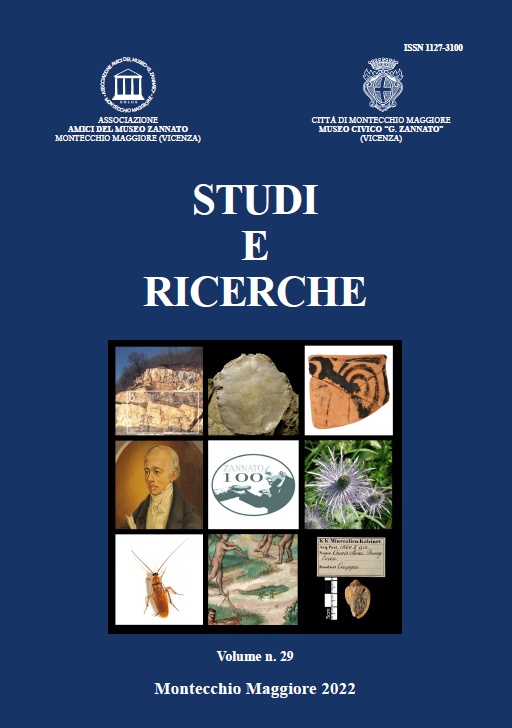
Since 1994, the museum has published its own scientific journal, Studies and Research, as well as a number of monographs and articles of a naturalistic or archaeological nature.
The Editorial Board annually evaluates the publication of contributions of high scientific value. Unpublished works concerning topics within the field of natural sciences and archaeology are considered for publication, with preference given to those concerning the Veneto region and in particular the Vicenza area; a maximum of 2 articles per Author/Co-Author can be published.
The papers are first evaluated by the Editorial Board of the Journal, which submits them for peer review by external experts: articles that do not respect the relevance of the journal or are manifestly far from the quality standards of the Journal may be directly rejected by the Editorial Board. There is no cost to Authors for publication.
Download here the Authors’ Guidelines
COMPLETE VOLUMES:
Articles Database
You can search and browse all works produced by the museum here, using tags or search or by scrolling through the catalog by year of publication.
2023
Dall’Olio G
“Malattia della Pietra” Mineralogia, chimica, medicina nella prima metà del XIX secolo Journal Article
In: Studi e Ricerche, vol. 30, pp. 21-29, 2023, ISBN: 1127-3100.
Abstract | Links | BibTeX | Tags: bladder calculi, chemistry, medicine, mineralogy, Stone disease
@article{Dall’Olio2023,

title = {“Malattia della Pietra” Mineralogia, chimica, medicina nella prima metà del XIX secolo},

author = {Giuliano Dall’Olio},

editor = {Associazione Amici del Museo - Museo Civico “G. Zannato” },

url = {https://www.museozannato.it/wp-content/uploads/2024/07/03_DallOlio.pdf},

isbn = {1127-3100},

year  = {2023},

date = {2023-12-31},

urldate = {2023-12-31},

journal = {Studi e Ricerche},

volume = {30},

pages = {21-29},

abstract = {RIASSUNTO

La “Malattia della pietra” o calcolosi vescicale, è una patologia nota fin dall’antichità e numerosi sono gli uomini di scienza che si sono occupati di studiare e combattere questa affezione nel corso dei secoli, impegno delegato, agli inizi, prevalentemente alla chirurgia.

Essendo i calcoli vescicali simili alle pietre, il primo passo nella cura della calcolosi vescicale è di approfondire le conoscenze delle loro caratteristiche mineralogiche e chimiche per poter migliorare i metodi chirurgici, diminuendo la mortalità dei pazienti e soprattutto individuare altri mezzi per “cavar la pietra” senza ricorrere a pericolosi e dolorosi interventi.

Impegnativa sarà la vagheggiata ricerca di sostanze liquide (litontritici) che, introdotte nell’organismo come bevande o diretta¬mente in vescica, possano sciogliere e ridurre i calcoli più voluminosi e farli così uscire direttamente per vie naturali con l’urina, ricerche iniziate fin dall’antichità ma che si rivelano essere di scarsa efficacia.

La presente comunicazione riporta l’opera di medici, mineralogisti e chimici della prima metà dell’Ottocento, quando la medicina e le scienze di base acquisiscono metodi che consentono di approfondire le ricerche.


ABSTRACT

“Stone disease”, bladder calculi, is a pathology known since ancient times and numerous scientists have studied and fought this disease over the centuries, a commitment delegated, at the beginning, mainly to surgery.

Since bladder concretions are similar to stones, the first step in the treatment of calculi in the bladder is to deepen the knowledge of their mineralogical and chemical characteristics in order to improve surgical methods, reducing patient mortality and above all to identify other means of “extracting the stone” without resorting to dangerous and painful surgical operation. Demanding will be the long-awaited search for liquid substances (lithontritics) which, introduced into the body as drinks or direct¬ly into the bladder, can dissolve and reduce the largest stones and thus make them come out directly through natural channels with the urine, researches begun since antiquity but which turn out to be of lacking effectiveness.

This paper reports the work of doctors, mineralogists and chemists of the first half of the nineteenth century, when medicine and basic sciences acquired methods that allowed for more in-depth researches.},

keywords = {bladder calculi, chemistry, medicine, mineralogy, Stone disease},

pubstate = {published},

tppubtype = {article}

}
La “Malattia della pietra” o calcolosi vescicale, è una patologia nota fin dall’antichità e numerosi sono gli uomini di scienza che si sono occupati di studiare e combattere questa affezione nel corso dei secoli, impegno delegato, agli inizi, prevalentemente alla chirurgia.
Essendo i calcoli vescicali simili alle pietre, il primo passo nella cura della calcolosi vescicale è di approfondire le conoscenze delle loro caratteristiche mineralogiche e chimiche per poter migliorare i metodi chirurgici, diminuendo la mortalità dei pazienti e soprattutto individuare altri mezzi per “cavar la pietra” senza ricorrere a pericolosi e dolorosi interventi.
Impegnativa sarà la vagheggiata ricerca di sostanze liquide (litontritici) che, introdotte nell’organismo come bevande o diretta¬mente in vescica, possano sciogliere e ridurre i calcoli più voluminosi e farli così uscire direttamente per vie naturali con l’urina, ricerche iniziate fin dall’antichità ma che si rivelano essere di scarsa efficacia.
La presente comunicazione riporta l’opera di medici, mineralogisti e chimici della prima metà dell’Ottocento, quando la medicina e le scienze di base acquisiscono metodi che consentono di approfondire le ricerche.
ABSTRACT
“Stone disease”, bladder calculi, is a pathology known since ancient times and numerous scientists have studied and fought this disease over the centuries, a commitment delegated, at the beginning, mainly to surgery.
Since bladder concretions are similar to stones, the first step in the treatment of calculi in the bladder is to deepen the knowledge of their mineralogical and chemical characteristics in order to improve surgical methods, reducing patient mortality and above all to identify other means of “extracting the stone” without resorting to dangerous and painful surgical operation. Demanding will be the long-awaited search for liquid substances (lithontritics) which, introduced into the body as drinks or direct¬ly into the bladder, can dissolve and reduce the largest stones and thus make them come out directly through natural channels with the urine, researches begun since antiquity but which turn out to be of lacking effectiveness.
This paper reports the work of doctors, mineralogists and chemists of the first half of the nineteenth century, when medicine and basic sciences acquired methods that allowed for more in-depth researches.
2021
Dall’Olio G
TOMASO ANTONIO CATULLO I MINERALI IN MEDICINA E IN FARMACIA Journal Article
In: Studi e Ricerche, vol. 28, pp. 35-47, 2021, ISSN: 1127-3100.
Abstract | Links | BibTeX | Tags: medicine, mineralogy, pharmacy, Tommaso Catullo
@article{nokey,

title = {TOMASO ANTONIO CATULLO I MINERALI IN MEDICINA E IN FARMACIA},

author = {Giuliano Dall’Olio},

editor = {Associazione Amici del Museo - Museo Civico “G. Zannato”},

url = {https://www.museozannato.it/wp-content/uploads/2022/08/05_DallOlio.pdf},

issn = {1127-3100},

year  = {2021},

date = {2021-12-31},

urldate = {2021-12-31},

journal = {Studi e Ricerche},

volume = {28},

pages = {35-47},

abstract = {RIASSUNTO

Viene presentato l’impiego dei minerali nella preparazione dei farmaci ed il loro uso in medicina dall’antichità fino ai primi decenni dell’Ottocento, esaminando in particolare il “Trattato di mineralogia applicata alla farmacia e alla medicina” di Tommaso Antonio Catullo pubblicato nel 1833. Viene anche tracciato il percorso professionale del Catullo dai primi incarichi di insegnante in alcuni licei veneti fino alla docenza all’Università di Padova. È riportata inoltre una diatriba connessa al suo legame con il territorio vicentino e alla sua competenza nell’analisi chimica.


ABSTRACT

TOMASO ANTONIO CATULLO, MINERALOGY APPLIED TO PHARMACY AND MEDICINE

The use of minerals in the preparation of drugs and their use in medicine from antiquity to the first decades of the nineteenth century is presented, examining particularly the “Treatise on mineralogy applied to pharmacy and medicine” by Tommaso Antonio Catullo published in 1833. The professional career of Catullo is also traced from his first teaching positions in some Venetian high schools to his appointment as professor at the University of Padua. A controversy connected to his link with the Vicenza area and his competence in chemical analysis is also reported.

},

keywords = {medicine, mineralogy, pharmacy, Tommaso Catullo},

pubstate = {published},

tppubtype = {article}

}
Viene presentato l’impiego dei minerali nella preparazione dei farmaci ed il loro uso in medicina dall’antichità fino ai primi decenni dell’Ottocento, esaminando in particolare il “Trattato di mineralogia applicata alla farmacia e alla medicina” di Tommaso Antonio Catullo pubblicato nel 1833. Viene anche tracciato il percorso professionale del Catullo dai primi incarichi di insegnante in alcuni licei veneti fino alla docenza all’Università di Padova. È riportata inoltre una diatriba connessa al suo legame con il territorio vicentino e alla sua competenza nell’analisi chimica.
ABSTRACT
TOMASO ANTONIO CATULLO, MINERALOGY APPLIED TO PHARMACY AND MEDICINE
The use of minerals in the preparation of drugs and their use in medicine from antiquity to the first decades of the nineteenth century is presented, examining particularly the “Treatise on mineralogy applied to pharmacy and medicine” by Tommaso Antonio Catullo published in 1833. The professional career of Catullo is also traced from his first teaching positions in some Venetian high schools to his appointment as professor at the University of Padua. A controversy connected to his link with the Vicenza area and his competence in chemical analysis is also reported.