
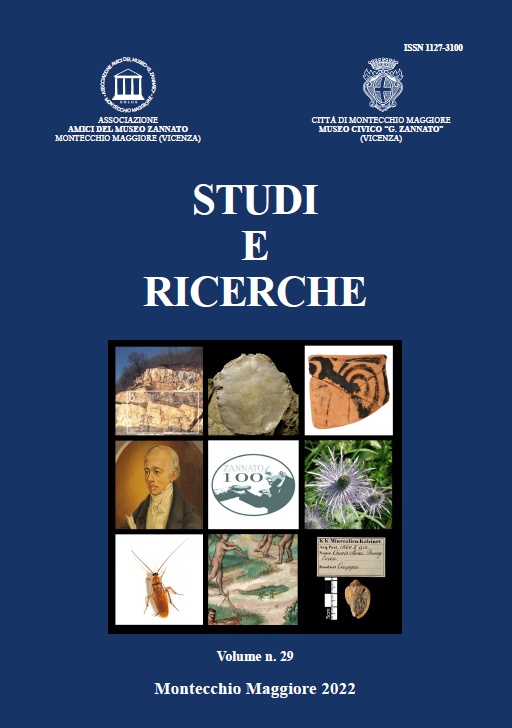
Since 1994, the museum has published its own scientific journal, Studies and Research, as well as a number of monographs and articles of a naturalistic or archaeological nature.
The Editorial Board annually evaluates the publication of contributions of high scientific value. Unpublished works concerning topics within the field of natural sciences and archaeology are considered for publication, with preference given to those concerning the Veneto region and in particular the Vicenza area; a maximum of 2 articles per Author/Co-Author can be published.
The papers are first evaluated by the Editorial Board of the Journal, which submits them for peer review by external experts: articles that do not respect the relevance of the journal or are manifestly far from the quality standards of the Journal may be directly rejected by the Editorial Board. There is no cost to Authors for publication.
Download here the Authors’ Guidelines
COMPLETE VOLUMES:
Articles Database
You can search and browse all works produced by the museum here, using tags or search or by scrolling through the catalog by year of publication.
2023
Beschin C
Colonne basaltiche di Gambellara (Vicenza - Italia nordorientale) Documentazioni inedite sugli usi espositivi Journal Article
In: Studi e Ricerche, vol. 30, pp. 11-20, 2023, ISBN: 1127-3100.
Abstract | Links | BibTeX | Tags: basalts, Geology, history of science, museums
@article{Beschin2023,

title = {Colonne basaltiche di Gambellara (Vicenza - Italia nordorientale) Documentazioni inedite sugli usi espositivi},

author = {Claudio Beschin},

editor = {Associazione Amici del Museo - Museo Civico “G. Zannato”},

url = {https://www.museozannato.it/wp-content/uploads/2024/07/02_Beschin.pdf},

isbn = {1127-3100},

year  = {2023},

date = {2023-12-31},

urldate = {2023-12-31},

journal = {Studi e Ricerche},

volume = {30},

pages = {11-20},

abstract = {RIASSUNTO

Vengono presentati le prime fasi e gli impieghi nel corso dell’Ottocento e del primo Novecento delle colonne basaltiche di Gam¬bellara (Vicenza, Italia nordorientale) in strutture espositive museali e platee geologiche. La documentazione inedita si conserva in larga parte al Museo Civico “G. Zannato” di Montecchio Maggiore. L’analisi offre uno spaccato dell’interesse che queste par¬ticolari strutture poligonali rivestivano per collezionisti, studiosi e istituzioni. Le colonne di Gambellara andarono ad arricchire musei d’Italia e d’Europa dove, in parte, ancora si conservano.


ABSTRACT

Basaltic columns of Gambellara (Vicenza, north-eastern Italy) unpublished documentation of exhibition use.

The first phases and uses during the nineteenth and early twentieth centuries of the basaltic columns of Gambellara (Vicenza) in museum exhibition structures and geological stalls are presented. Most of the unpublished documentation is preserved at the “G. Zannato” Civic Museum in Montecchio Maggiore. The analysis offers an insight into the interest that these particular polygonal structures held for scholars, collectors and institutions. The columns of Gambellara went on to enrich some museums in Italy and Europe in wich, in part, they are still preserved.},

keywords = {basalts, Geology, history of science, museums},

pubstate = {published},

tppubtype = {article}

}
Vengono presentati le prime fasi e gli impieghi nel corso dell’Ottocento e del primo Novecento delle colonne basaltiche di Gam¬bellara (Vicenza, Italia nordorientale) in strutture espositive museali e platee geologiche. La documentazione inedita si conserva in larga parte al Museo Civico “G. Zannato” di Montecchio Maggiore. L’analisi offre uno spaccato dell’interesse che queste par¬ticolari strutture poligonali rivestivano per collezionisti, studiosi e istituzioni. Le colonne di Gambellara andarono ad arricchire musei d’Italia e d’Europa dove, in parte, ancora si conservano.
ABSTRACT
Basaltic columns of Gambellara (Vicenza, north-eastern Italy) unpublished documentation of exhibition use.
The first phases and uses during the nineteenth and early twentieth centuries of the basaltic columns of Gambellara (Vicenza) in museum exhibition structures and geological stalls are presented. Most of the unpublished documentation is preserved at the “G. Zannato” Civic Museum in Montecchio Maggiore. The analysis offers an insight into the interest that these particular polygonal structures held for scholars, collectors and institutions. The columns of Gambellara went on to enrich some museums in Italy and Europe in wich, in part, they are still preserved.